
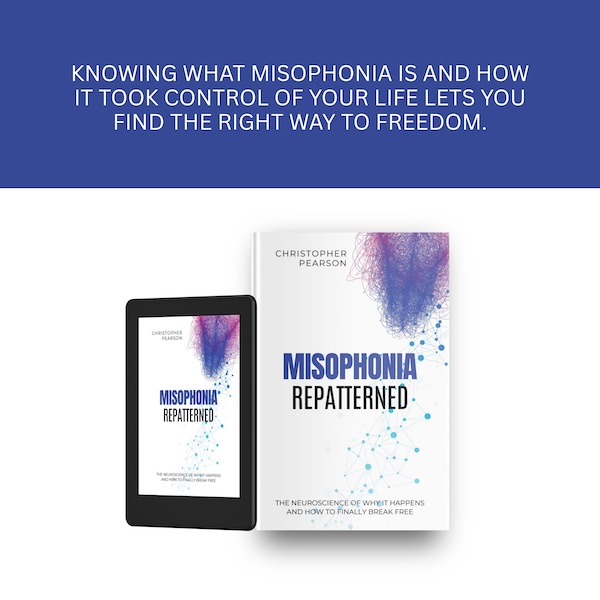
Misophonia – Why it Happens and How to Break Free
After many years of developing Sequent Repatterning, researching misophonia, and helping people affected by it, Chris Pearson has brought his experience together in Misophonia Repatterned: The Neuroscience of Why It Happens and How to Break Free.
In this book, Chris explains both the how and the why of misophonia. He shows how life’s experiences can plant a seed that may one day grow into misophonia, because the brain is a prediction machine.
Drawing on the concept of Bayesian prediction, he explains why the same processes that help us survive can, in some circumstances, lead to unwanted and overwhelming responses to particular sounds, sights, and other sensory cues.
But these responses are not fixed. Just as the brain adapts to everyday experiences, it can also update the learned emotional patterns that drive unwanted symptoms. Chris explains the process known as memory reconsolidation, and shows how it can help make lasting change possible.
In Misophonia Repatterned, Chris Pearson brings together more than twenty years of study, clinical practice, and therapeutic innovation to offer a new and hopeful understanding of misophonia.